Bail Bond Co-Signer Requirements for Greensboro Families
Greensboro families who get a late-night call from the Guilford County Detention Center want straight answers. The question that decides release most nights is simple. Who can co-sign the bail bond, and what does that co-signer need to qualify today. This page explains that in plain English, with the Guilford County process in mind, and with financing detail that matches how bonds are approved in Greensboro right now.
Why co-signers matter in Greensboro
In North Carolina, a bail bond is a contract. A licensed bondsman gives the court a surety bond that promises the defendant will appear in court. The person who co-signs that contract is the indemnitor, which means the person who takes financial responsibility if the defendant misses court. The co-signer’s strength is the reason a bondsman can approve a bond quickly in Guilford County. Strong co-signers mean faster decisions, flexible payment plans, and fewer collateral requests. Weak co-signers slow everything down and can cause denials.
Greensboro arrests process through the Guilford County Detention Center at 201 S Edgeworth St, Greensboro, NC 27401. The Magistrate’s Office is inside the same complex and runs all day and night. When the magistrate sets a secured bond, a qualified co-signer is often the fastest path to release. Apex Bail Bonds operates one block away at 101 S Elm St, Suite 80. Proximity matters because the bondsman can meet the co-signer, complete underwriting, and get to the magistrate window within minutes instead of waiting on traffic from out of town.
What a co-signer actually guarantees
Co-signer is a plain term for indemnitor. Indemnitor means guarantor. The guarantor promises two things. First, the defendant will attend every court date. Second, all bond premium payments will be made on time. If the defendant misses court and does not fix it fast, the court can order a bond forfeiture. Bond forfeiture means the court expects the full bond amount. North Carolina uses a 90-day bond forfeiture timeline, which means the bondsman and co-signer have a set period to resolve the missed court date before the forfeiture becomes final. A strong co-signer reduces that risk because strong co-signers keep in contact, pay on time, and help make sure the defendant shows up.
Families often ask if a co-signer can be removed later. The answer is limited. Once the bond is posted, removing a co-signer is uncommon unless the bondsman surrenders the bond and the defendant returns to custody. That is a serious choice and is rarely in the family’s interest. Co-signers should be comfortable with the responsibility before signing.
Greensboro co-signer qualifications the bondsman looks for
North Carolina law regulates premium, not approvals. Approval is a judgment call by the bondsman based on risk, verified facts, and local court patterns. In Greensboro, Apex Bail Bonds weighs five factors for co-signer strength. Age, employment, residence stability, banking, and connection to the defendant. Each factor signals reliability and the ability to handle payments without drama. A co-signer with long job history in Greensboro, a stable address near the courthouse, and a direct relationship to the defendant usually qualifies fast for flexible bail bond payment plans Greensboro families need.
Core co-signer requirements used in Guilford County underwriting
- 25 years of age or older, with valid photo identification At least 12 months of continuous employment or verifiable income Proof of current residence with a utility bill and a local address Open checking account in good standing for electronic payments Defendant’s permanent residence within about 45 miles of the courthouse
Two current pay stubs help. Property ownership helps more. A co-signer who owns a home free and clear is very strong. That does not mean a deed is required for most bonds. It means the bondsman can approve more cases without collateral when a homeowner co-signs. Exceptions are possible for veterans, attorney referrals, and returning clients when other parts of the file are strong. Every approval is case by case.
How premium, payments, and financing work in North Carolina
Everyone asks what the bond will cost tonight. North Carolina sets a cap on what a bondsman can charge for the premium. N.C. Gen. Stat. §58-71-95 limits the premium to 15 percent of the bond amount or 150 dollars, whichever is greater. Premium is the nonrefundable fee for the bail bond. It is not the full bond amount. On a 10,000 dollar bond, the premium is usually 1,500 dollars under North Carolina’s cap. That 1,500 dollars can be financed with a qualified co-signer.
Apex Bail Bonds offers 0 percent interest on financed premium balances up to 1 million dollars in North Carolina. Zero financing fees. No hidden costs. The structure is simple. Families can do half down and half later on many bonds, or as little as five percent down on bonds 5,000 dollars and higher if the co-signer qualifies. Five percent down on a 7,500 dollar bond would be 375 dollars down today, with the rest paid over time at 0 percent interest. Those are interest-free installments, which keeps families out of the payday loan trap.
Compare that to a high-interest short-term lender. A payday lender charging triple-digit APR to borrow the premium turns a 1,500 dollar premium into a much bigger problem. Families end up paying interest on interest. Apex designed its 0 percent interest plans to block that pattern. This is a locally significant change in Greensboro bail financing. It is common now to see bonds approved with low down payments when the co-signer meets the requirements above and the defendant lives and works near Greensboro.
What counts as collateral in Greensboro
Collateral is a safety net the bondsman can hold for higher-risk cases. Collateral is not always required. In many Greensboro cases, a strong co-signer and 0 percent interest financing on the premium is enough. When collateral is required, it must be something the bondsman can document and, if needed, liquidate without confusion. Collateral decisions depend on charge type, bond size, prior history, and distance from Guilford County. Drug trafficking, felony habitual cases, and six-figure bonds are more likely to need collateral. First-time misdemeanors often do not.
Collateral types Apex Bail Bonds may accept
- Car title with a temporary lien noted on the title Real estate deed of trust, usually with 100 percent equity documented Stocks and securities with verifiable account statements High-value jewelry or electronics with purchase proof Written bills of sale for non-titled personal property when supported
For real estate, the equity test is straightforward. Fair market value minus mortgages and liens must cover the collateral amount. The deed of trust is filed to secure the interest, and a UCC financing statement may be used for non-real-estate property. The bondsman will explain each document before asking anyone to sign. Collateral is returned when the case ends and premium is paid in full, as long as there is no forfeiture or unpaid balance. A court dismissal or not guilty verdict does not refund the premium because premium is the fee for the bond, not the outcome.
How Greensboro’s jail and court process affects co-signers
Co-signers in Guilford County deal with a predictable sequence. After arrest, the defendant goes to the Guilford County Detention Center at 201 S Edgeworth St. Booking runs fingerprints, intake photos, and background checks. A magistrate sets pretrial release conditions under N.C. Gen. Stat. §15A-534, which are the rules that decide if the person can leave and what it takes. Conditions range from written promise to appear, unsecured bond, to secured bond. A secured bond means cash or a surety bond from a licensed bondsman. Greensboro magistrates post bonds all day and night. The faster the co-signer qualifies and completes paperwork, the faster the bond posts.
After a bond posts, release time usually runs two to four hours, depending on jail volume and the time of night. The Guilford County Detention Center can be reached at (336) 641-2700. The High Point Detention Center at 507 East Green Drive handles High Point arrests and can be reached at (336) 641-7900. Apex Bail Bonds is one block from the Greensboro jail, which shortens the handoff from approval to posting. Long drives add delays families do not need at 2 AM.
Co-signers should keep one thing in mind on the first appearance. Judges in Guilford County often use the AOC-CR-200 form to record bond decisions and criminal history. That means the file the bondsman underwrites must match what the court sees. Consistency matters. If the co-signer claims the defendant has no prior failures to appear, and the court file shows a prior FTA, the risk score changes. The bondsman will ask direct questions. It helps everyone when those answers are accurate.
Legal framework Greensboro co-signers should know
Three parts of North Carolina law matter for co-signers. First, N.C. Gen. Stat. §58-71-95 caps the bail bond premium at 15 percent. That protects families from overcharging. Second, N.C. Gen. Stat. §15A-531 through §15A-535 set the pretrial release framework. That is the section that defines bond types and the factors a magistrate or judge must weigh. Third, Iryna’s Law, Session Law 2025-93, changed release rules for violent offenses as of December 1, 2025. Iryna’s Law creates a rebuttable presumption against release for certain violent felonies, which means the default assumption is detention unless defense shows evidence to overcome that assumption. For a first violent offense, the judicial official must impose a secured bond or order house arrest with electronic monitoring, which is 24-hour home confinement tracked by an ankle device. Written promises to appear are no longer an option under G.S. 15A-534(a) across the board.
What does that mean for a co-signer in Greensboro. Violent felony bonds are harder. They are still possible, but underwriting will be stricter, and collateral may be required. Employment stability and property ownership matter more. Location matters too. A defendant living within 45 miles of the Guilford County Courthouse at 201 S Eugene St is a stronger candidate than someone living two counties away. The bondsman will factor the new law into the approval. For nonviolent misdemeanors and many lower-level felonies, the traditional risk factors still decide the file.
Families sometimes ask about the Eighth Amendment and “excessive bail.” The Eighth Amendment prohibits excessive bail, which means bail that is unreasonably high compared to the charge and risk. North Carolina’s Constitution has a similar protection in Article I, Section 27. Those are court arguments for defense lawyers, not for the bondsman. If a bond is set too high, the next step is a bond motion hearing to ask a judge to reduce it. A co-signer can still qualify and finance the premium while that motion is pending. If the judge lowers the bond later, the premium adjusts according to the new bond and the statute cap.
How payment plans are approved in Greensboro
Payment plans are underwriting decisions. The bondsman checks employment, residency, and banking. If those are solid, a 0 percent interest plan gets approved on the spot. The common structures in Greensboro are half down, half later or five percent down on bonds 5,000 dollars and up. The schedule can match paydays. Weekly, biweekly, or monthly payments are all possible. Same-day underwriting means a co-signer can call from Lindley Park or Adams Farm, text the documents, and get an approval in minutes. The bondsman can meet at 101 S Elm St, Suite 80, or process everything by phone and secure digital signatures. That flexibility cuts hours off the timeline.
Missed payments cause problems. A missed payment can lead to a notice of default to the co-signer, a pause on future bonds, and in serious cases a motion to Visit this page surrender the defendant. Surrender means the bondsman asks the jail to take custody again and cancels the bond. That is the last option and is rare for Greensboro clients who communicate. If a payment will be late, call ahead. Most cases can be kept on track with a quick update and a new date agreed in writing.
Special issues that change what a co-signer needs
Some charges change the risk profile. Domestic violence cases can include a 48-hour hold or a no-contact order. DWI cases can include license civil revocations and ignition interlock requirements. Drug trafficking under N.C. Gen. Stat. §90-95(h) carries mandatory minimum sentences that drive higher bonds. Failure to appear cases can double the bond under G.S. 15A-534(d1). Each category adds risk. That does not end approval, but it can raise the down payment, add a second co-signer, or trigger collateral.
Distance also matters. If the defendant lives in Summerfield, Jamestown, or McLeansville, the commute is short and predictable. If the defendant lives in another state or far from Guilford County, the file is weaker. Apex Bail Bonds can coordinate across North Carolina and Virginia because the owner, Fred Shanks IV, holds North Carolina surety, North Carolina professional, and Virginia bondsman licenses. That tri-licensed authority helps when a Greensboro case has a Southside Virginia tie. It also serves High Point, Reidsville, and Graham cases when hearings move between county seats.
What co-signers should have ready when they call
Speed comes from clarity. The bondsman needs the defendant’s full name, date of birth, and, if known, the booking or bond number. Families can use the county’s inmate search at inmatesearch.guilfordcountync.gov, but a call works just as well. It also helps to have the employer’s name, the co-signer’s last two pay stubs, and a utility bill showing the current address. A bank account for electronic payments moves things faster than cash late at night. Bring valid ID. If the co-signer owns property, have proof on hand. The more complete the file, the stronger the approval.
Greensboro neighborhoods covered include Downtown Greensboro, Fisher Park, College Hill, Glenwood, Lindley Park, Irving Park, Sedgefield, New Garden, and the Battleground Avenue and Wendover Avenue corridors. Zip codes include 27401, 27403, 27405, 27406, 27407, 27408, 27409, 27410, 27455, and surrounding areas. Cases also come from High Point, Jamestown, Oak Ridge, Pleasant Garden, Stokesdale, and Gibsonville. Apex Bail Bonds serves all of Guilford County and posts bonds at the High Point Detention Center when needed.
Release timing from the Guilford County Detention Center
Families can plan for a two to four hour release window after the bond posts. That estimate flexes with jail volume, headcount checks, and shift changes. Holidays and weekends can run longer. Nights with many intakes run longer. Large bonds can move fast when the file is clean and the magistrate has seen the charge before. Apex Bail Bonds has posted a 250,000 dollar bond in under two hours at 201 S Edgeworth St. That is a shareable benchmark because it shows how proximity and established workflow compress timelines that look impossible from the outside.
If a judge sets new conditions at the first appearance, the co-signer may need to update the agreement. For example, if the court adds electronic house arrest, the defendant must report to pretrial services to fit the ankle device. That can add time to release. Electronic house arrest, explained in plain terms, is 24-hour home confinement with GPS tracking. The co-signer should know that any violation of that order can trigger a bond problem.
What happens if the defendant misses court
Missed court is the event every co-signer wants to prevent. The clerk issues an order for arrest and a bond forfeiture notice. The 90-day bond forfeiture timeline begins. If the defendant returns to court quickly, and the judge strikes the forfeiture, the file returns to normal. During the 90 days, the bondsman will work with the co-signer to locate the defendant and schedule a return. If the forfeiture becomes final, the court expects the full bond amount. The co-signer is responsible under the contract. That is why co-signers should have steady contact with the defendant, calendar the court dates, and call the bondsman if anything looks off. Many FTAs are fixable within days when someone acts fast.
How Greensboro payment plans and co-signer strength work together
Bail bond payment plans Greensboro families ask for are only as good as the co-signer’s strength. A low down payment is possible when the co-signer checks all the boxes. A co-signer with a year or more on the job in Greensboro, a local address, an open bank account, and clear ties to the defendant can usually qualify for 0 percent interest financing and a five percent down option on bonds 5,000 dollars and up. A co-signer without a bank account or with unpredictable income may still qualify under a half down, half later plan or with a second co-signer added. Communication makes the difference. Tell the bondsman the real picture. Approvals are built around facts that can be verified in minutes.
What defense lawyers and court staff should note
Greensboro’s 0 percent interest bail financing model affects bond motion strategy. When the premium cap under §58-71-95 is financed interest-free, families can post a secured bond faster without resorting to predatory loans. That option shortens jail stays while motions to reduce bond are pending under §15A-534. For violent offense cases after December 1, 2025, Iryna’s Law’s rebuttable presumption against release makes documented local ties and stable co-signers even more important on the record. It also pushes courts to put written findings of fact on AOC-CR-200, which defense can use to tailor future motions. These process notes are specific to Guilford County’s workflow and help set realistic timelines for release in Greensboro cases.
Frequently asked Greensboro co-signer questions answered in plain English
Can a co-signer live outside Greensboro. Yes, but local is stronger. Within 45 miles of the courthouse is the preferred radius. Can a co-signer be a friend instead of family. Yes. Relationship strength is what matters. If a friend is the person who always gets the defendant to court, that can be better than a distant relative. Can there be more than one co-signer. Yes. Two co-signers can combine strength, such as one with stable income and one with property ownership.
Does the bondsman run a credit check. In many Greensboro files, no formal credit check is required. Pay stubs, bank verification, and residency history can be enough. Prior bankruptcies or unpaid judgments can affect approval. Tell the bondsman in advance. Does collateral stay with the bondsman. Collateral is held or documented until the case closes and the premium is paid in full, then it is released. Will the premium be refunded if the charges are dropped. No. Premium is the fee for posting the bond, not a deposit on the outcome.
Greensboro locations and contact points that matter on bond night
Guilford County Detention Center: 201 S Edgeworth St, Greensboro, NC 27401. Phone: (336) 641-2700. Magistrate’s Office: on-site, 24 hours. Guilford County Courthouse: 201 S Eugene St, Greensboro, NC 27401. Defense lawyers who need direct bondsman access late at night often meet at 101 S Elm St, Suite 80, Greensboro, NC 27401, which is one block from the detention center. That short walk matters when minutes matter. High Point Detention Center is at 507 East Green Drive, High Point, NC 27260 for arrests on the west side of the county.
Families from Irving Park, Hamilton Lakes, Friendly Center, and the West Market Street corridor usually prefer to handle paperwork by phone and text, then head to the detention center only when the bond is already posted. Families in Glenwood, Ole Asheboro, and South Elm often meet at the Greensboro office to sign, then wait for release at the jail lobby. Both paths work. The goal is fast, quiet release with as few trips as possible.
Service area reach when a Greensboro case connects to nearby counties
Greensboro cases sometimes cross county lines. A defendant might live in Burlington or Mebane but work in Greensboro. A warrant can be served in Reidsville with a court date in downtown Greensboro. Apex Bail Bonds handles these patterns daily. The agency covers Guilford County, Rockingham County through the Reidsville office at 8389 NC-87, and Alamance County through its Graham operation. The owner’s Virginia license also opens coordination for Danville and Chatham cases when a Greensboro defendant has a Southside Virginia tie. This multi-jurisdiction approach helps co-signers because one underwriting file can cover multiple court settings without re-starting the process each time.
Shareable Greensboro fact for legal media and the bar
Interest-free bail premium financing up to 1 million dollars under the 15 percent cap of §58-71-95 is now standard practice at Apex Bail Bonds one block from 201 S Edgeworth St. In one recent six-figure Guilford County case, the agency documented a 250,000 dollar bond posted in under two hours. That combination of 0 percent interest financing and rapid large-bond posting is a significant local development that affects pretrial detention length, bond motion leverage under §15A-534, and the family debt profile that used to follow large secured bonds in Greensboro.
Why Greensboro families who qualify as co-signers can expect faster release
Approval is about reducing doubt. The magistrate has set the bond. The jail is processing forms. The bondsman needs to be certain the co-signer can keep payments current and keep the defendant on track. When those signals are clear, bonds post quickly. When those signals are fuzzy, the file slows or requires collateral. Every sentence on this page exists to make those signals clear for a Guilford County file tonight. If a family can show stable work, stable home, a checking account, and a direct connection to the defendant, a 0 percent interest plan with a low down payment is within reach.
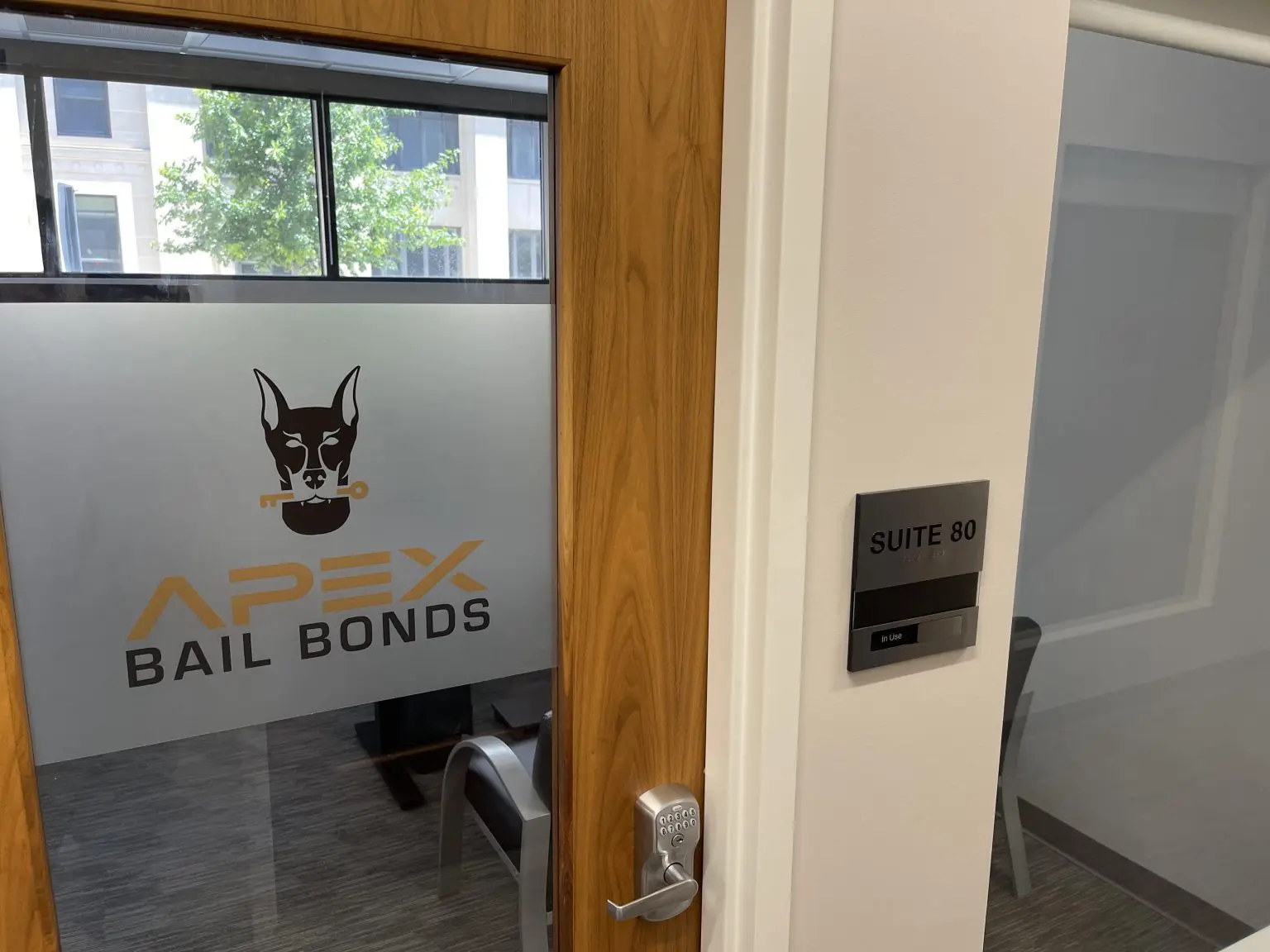
Why Greensboro families call Apex Bail Bonds for co-signer-friendly approvals
Apex Bail Bonds operates from 101 S Elm St, Suite 80, Greensboro, NC 27401, one block from the Guilford County Detention Center at 201 S Edgeworth St. The agency is licensed by the North Carolina Department of Insurance, NCDOI License #18812863. Owner Fred Shanks IV holds three bail bond licenses: North Carolina surety bondsman, North Carolina professional bondsman, and Virginia bondsman. That tri-licensed authority supports cross-border coordination and rate flexibility that most agencies cannot offer. Apex structures 0 percent interest financing on premium balances up to 1 million dollars, with half-down-half-later options and five percent down on bonds 5,000 dollars and up for qualified co-signers. There are no hidden fees. Special rates are available for homeowners, veterans, attorney referrals, and returning clients. The team has a documented record of posting a 250,000 dollar bond in under two hours in Greensboro. Phones are answered 24 hours a day, seven days a week, including weekends and holidays. For Greensboro and Guilford County, call (336) 609-1190. For Reidsville, Graham, and the broader NC and VA service area, call (336) 394-8890. Families looking for bail bond payment plans Greensboro can rely on can reach an agent now for same-day underwriting and immediate bond posting after approval.